Showing posts with label Birding in Asia. Show all posts

Saturday, April 8, 2017

Vultures need you

African & Eurasian Vultures are in severe trouble—most species perilously close to extinction. We're calling for contributions to a new 12-year Action Plan to save them. Article originally published by BirdLife International 24th March 2017.

By Shaun Hurrell


Let’s face it: vultures are special. Part of human culture, they are seen as disgusting by some, yet loved by others (including us and you). Asia’s vultures have suffered some of the fastest population declines ever recorded in a bird, and Africa’s recent severe declines mean that now most old-world vultures are on the edge of extinction. With a unique scavenging niche, this group of birds clean our landscapes and help to prevent the spread of disease—among the many reasons why we are doing all we can to save them. BirdLife’s vulture campaign has already shown how many people love and value vultures, and now there is a chance for some of you to input technical comments on the draft plan that sets out how best to conserve them.
Today we promote a public consultation on a new draft Multi-Species Action Plan to conserve African-Eurasian Vultures, launched by the Coordinating Unit of the Convention on Migratory Species (CMS) Raptors MOU, in collaboration with BirdLife International, Vulture Conservation Foundation and the IUCN Vulture Specialist Group. (The CMS Raptors MoU is the Memorandum of Understanding on the Conservation of Migratory Birds of Prey in Africa and Eurasia—an international, legally non-binding agreement to protect migratory birds of prey.)
In total, 127 countries are lucky to have recorded vultures in their skies.
This plan, if adopted by the Parties to CMS in October this year, would mean these countries being requested to take decisive action over twelve years to save vultures. The Plan would also guide states that are not Parties to CMS, as well as many other actors. This includes actions to protect vultures across Africa, Asia and Europe from all of threats sadly faced by these birds: poisoning, persecution, collision with energy infrastructure, habitat loss, and many more.
Whilst we are doing all we can to ensure a future for these special birds it is, above all, Governments that have the resources to solve this problem at the huge scale required.
An adopted Action Plan would also guide foreign investors and international agencies on how to take vulture conservation into account in development plans and projects.
The Action Plan identifies and concerns all relevant stakeholders in vulture conservation, from the health sector to renewable energy developers, trade regulation bodies and many others. So, if you are: a national governmental authority (e.g. Environment Ministry, Wildlife and Forest Service, etc.), conservation organisation, university, research institution, consultant, technical expert, ornithologist, or someone interested in the conservation of the African-Eurasian vultures, please get in touch to contribute to this technical document.
Together, we can achieve the objectives of the Action Plan: rapidly halt current population declines in all the species it covers; reverse recent population trends to bring the conservation status of each species back to a favourable level; and, provide conservation management guidelines applicable to all Range States covered by the Plan.
The only African-Eurasian vulture species not included in the Plan is the Palm-nut Vulture, nicknamed the “vegetarian vulture”, which is not currently threatened by the largest problems faced by others. But for the rest, action must be taken immediately. Eight out of 15 African-Eurasian vulture species are Critically Endangered. Three are Endangered and two are Near Threatened.
Vultures need you, now:
The Convention on Migratory Species, together with BirdLife and partners, are calling for technical feedback on the draft Multi-Species Action Plan to Conserve African-Eurasian Vultures (Vulture MsAP). Almost 300 government officials, partners, vulture specialists and other interested individuals have already contributed to its development, but your expertise can help shape this important plan:
  • Do you have information on the status of vultures, or threats to their survival (that are not already included in the document)?
  • What new solutions to threats facing vultures do you think should also be included?
  • Or, if everything has been covered, please let us know if you support the plan in its current state.
You have less than a month to input for vulture conservation, so please be fast.
Comments on the 2nd Draft Vulture MsAP should be submitted via email to cmsoffice.ae@cms.int by 16 April 2017.  All comments received during the consultation period will be reviewed and, where appropriate, integrated into a final version of the Vulture MsAP, due to be completed by mid-May 2017 for formal submission to the CMS Secretariat.  The Vulture MsAP is expected to be considered by Parties to the Convention on Migratory Species (CMS) at the 12th Meeting of the Conference of the Parties (COP12), scheduled to be held in Manila, Philippines in October 2017.
Important information:

Monday, November 2, 2015

EU Inaction Threatens Vultures

Despite proof that diclofenac kills vultures and other carrion feeders, the EU approved and continues to allow the use of this harmful veterinary drug. Despite the proven toxicity of this drug, the chemical company responsible, in full knowledge of its harmful impact on wildlife, continues to peddle and promote its use in Europe. Even more remarkable is Spain, under the guise of the Spanish Agency for Medicines, approved this harmful drug for use by veterinarians on pigs and cattle within Spain. Serious questions really need to be asked how this has happened?

In December 2014 the European Medicines Agency (EMA) had published their long awaited technical position on the vulture-killing drug diclofenac, following a request from the European Commission, they confirmed that veterinary diclofenac does represent a real risk to European vultures, and therefore recommended that a number of risk management measures should be taken to avoid the poisoning of vultures, including more regulation, veterinary controls, better labeling and information and/or a ban of the drug.

The EMA´s position fell short of recommending one or more of the possible solutions listed as they did not have enough elements and/or remit to evaluate their effectiveness, although they recognize that only a ban would reduce the risks to zero. It was up to the EU Commission to decide if they would start a formal referral process reviewing the marketing authorization of veterinary diclofenac (approved for sale in 5 EU countries, including Italy and crucially Spain, which holds 90% of all European vultures). Veterinary diclofenac is marketed by the Italian company FATRO, which used loopholes in the EU risk assessment guidelines for veterinary drugs to get it approved in Italy and Spain, in spite of a solid and massive body of evidence about its impacts on vultures and other wildlife.


Veterinary diclofenac has caused a massive decline in vultures in the Indian subcontinent (95% declines of several species, driving to extinction some of the most abundant vulture species in the world in the last 20 years), and was finally banned there. Vultures provide key ecosystem services, removing tons of livestock carcasses from the countryside, and helping to control disease.

Due to the high standards of drug control in Europe, compared to countries like India, conservationists had not been overly worried about instituting a diclofenac ban in Europe. In fact, nine vulture conservation projects had already received 10.7 million Euro (nearly $15 million) between 2008 and 2012. It is thus puzzling that in the spring of 2013, the Spanish Agency for Medicines authorized the use of diclofenac by veterinarians on pigs and cattle within Spain. Other European countries are also marketing diclofenac —in Italy, it is available under the name Reuflogin for use on horses, cattle and pigs.

Spain contains eight of Europe’s ten vulture species. Of these, four are considered rare and threatened, and receive some protection under European law. The Egyptian vulture (Neophron percnopterus) is Endangered and the cinereous vulture (Aegypius monachus) is Near Threatened, while two others, the griffon vulture (Gyps fulvus) and the bearded vulture (Gypaetus barbatus), have benefited from decades of conservation efforts and have gradually recovered population numbers.


A technical report on diclofenac published by the Vulture Conservation Foundation emphasizes the magnitude of Spain’s role in vulture conservation: “With more than 70,000 griffon vultures (90% of the European population), 5,000 cinereous vultures (97% of the European population), 3,000 Egyptian vultures (85% of the European population) and 300 bearded vultures (67% of the European population), Spain is the most important country on the continent for these species—and for some of them (e.g griffon and cinereous vulture) the most important country in the world.”

Okay, fast forward to November 2015 and what is the EU doing to prevent the danger to ‘our’ European vultures? Well I can do no better than to quote Chris Bowden (RSPB’s Globally Threatened Species Officer, and Programme Manager of the consortium of ‘SAVE’ partners – Saving Asia’s Vultures from Extinction) from his recent guest blog  on Mark Avery’s Standing up for Nature.

"The latest headlines for European vultures remain that one Italian pharmaceutical company, ‘Fatro’, recently managed (under the radar) to get diclofenac licensed for veterinary use in Italy and then with EU approval, when they surely knew all about the story in Asia. Unfortunately, no-one concerned at the EU was sharp enough to spot this and prevent it from happening. It was only when Fatro extended their market to Spain two years ago (Spain holds 80% of Europe’s vultures), that anyone noticed. Conservation groups concerned with the welfare of world populations of vultures, mistakenly assumed that this couldn’t happen in Europe – how so very wrong and embarrassing that has proved to be! It isn’t that conservation groups don’t have support from some of the higher bureaucratic spheres and veterinarians, but once the approval had been given (and despite various pleas to the company concerned and to the EU to ‘do the right thing’), it is now clear we must await dead vultures proved to have been killed by the drug – something that takes huge efforts, expertise and some considerable expense to demonstrate, before any veterinary diclofenac ban will be declared for Europe. The only steps agreed to are some additional labelling, and the excuse that regulations will be adhered to more strictly – something we already have evidence is not entirely the case. It wouldn’t be quite so exasperating if there weren’t viable safe alternatives such as meloxicam available to the vets. The combination of the Vulture Conservation Foundation, BirdLife Partners from Spain, Italy, UK and the Secretariats in Brussels and Cambridge as well as motivated individuals, zoos and veterinary organisations has so far succeeded in raising the issue, but not getting the step we really need".

So what can we do? How can we be kept up to date with the current situation, not just in Europe but also elsewhere? There are a few organisations working together to fight for our vultures and also a petition to add your voice to those of us concerned for vulture welfare and conservation.

You can add your voice (or signature) to the campaign here.

Get any further updates and background here from VCF.


And some good news. Iran bans diclofenac see here.

Credits.
Vulture Conservation Foundation
Mark Avery
Chris Bowden
RSPB
Birdlife International
Vulture Specialist Group
SAVE
VULPRO
#LoveVultures


Wednesday, October 14, 2015

International Vulture Awareness Day


Himalayan Griffon Vulture
I want to celebrate and share with you International Vulture Awareness Day. These wonderful and spectacular families of birds, which I always promote with the term 'beautifully ugly', are an essential part of our world. Feeding largely on rotting carcasses, preventing the resulting spread of deadly disease, you would think people would do everything to conserve and preserve these creatures. Well, intentional and inadvertent interference by humans has pushed many species of vulture to the very edge of extinction. #LoveVultures
European Griffon Vulture
The vultures of our planet are classified into two groups: Old World and New World. The two groups are not related, similarities between them are considered to be a result of convergent evolution rather than any close relationship. In Eurasia only Old World vultures are found and unlike New World vultures, which have a highly developed sense of smell, Old World vultures find carcasses exclusively by sight like other birds from this family do with their living prey.

So what makes vultures so special? Well, to repeat myself and strengthened their case, you have to understand they feed mostly on carcasses of dead animals, generally not killing their own prey. As scavengers they play such an important role in the ecosystem, assisting the decomposition of dead animal matter, cleansing the environment and most importantly for us, they reduce the spread of harmful diseases. In short, there is no reason to harm this group of birds and every reason to support efforts to conserve them.
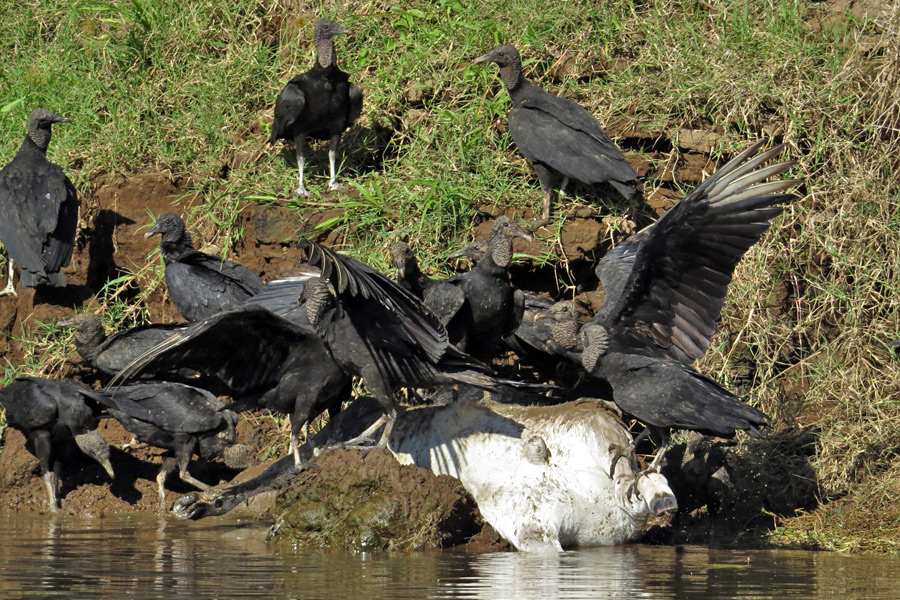
Black Vulture feeding on a carcass
What are the current dangers to vultures? You may have guessed it, human interference, intentional and unintentional. Old World and New World vultures are under threat, the consequences of which has and will impact on us all. Here are just a few of the problems faced by vultures from human interference.

1. United States, the California condor has struggled to maintain a sustainable population as lead poisoning continues to be the single most important threat to its survival. Hunters using lead ammunition will at times wound target species and allow them to die in remote locations. Condors feeding on the carcass ingest the lead shot and as a result are slowly poisoned to death.
2. In Eurasia it has been found that the use of Diclofenac, a painkiller for livestock and humans in India and Nepal, has caused staggering countless thousands of vulture deaths. Recently, Diclofenac has been banned, but conservationists argue that it has come too late to allow for survival of vulture species decimated by its initial use.
3. In African countries, such as Kenya and Namibia, farmers targeting lions and other predatory species that they consider a threat to livestock and humans lace carcasses with the extremely toxic carbamate pesticide Furadan. Animals that ingest Furadan suffer horrible deaths and then themselves pose a huge health risk to other scavenger species that ingest their carcass perpetuating this deadly act.
4. Across the European Union scavengers are threatened with extinction owing to a well intended, but ill-conceived regulation introduced by the EU government in Brussels. This regulation (1774/2002) dates from the year 2002, where the fear of BSE or “mad cow disease” was rampant in Europe and the EU, which issued a number of new directives to protect the population as much as possible from exposure to the epidemic. As part of these new regulations, it was decreed that dead cows, sheep, goats and horses would need to be disposed of in a licensed animal disposal facilities. Before this new regulation it was normal that when farmed animals died in remote and inaccessible pastures, particularly in Mediterranean countries, they were either left where they were or taken to designated carcass dumps.
Greater Yellow-headed Vulture
Notes on other threats to world vulture populations.

In the EU, Diclofenac has been authorised in animals since 1993. Currently, the medicine is authorised for use in cattle, pigs and horses in five Member States. Conservation organisations, citizens and politicians have expressed their concerns over the risks that Diclofenac may present to vultures and other necrophagous bird populations in the EU. In September 2014, the European Commission asked EMA to investigate whether the use of Diclofenac in animals presents a risk to vultures and other necrophagous birds in Europe and, if a risk is identified, to provide an opinion on actions or mitigation measures that could be implemented to manage this risk effectively.

Africa's vulture population is in danger from illegal elephant and rhino poachers, a South African conservation group is warning. VulPro says poachers have been poisoning the carcasses to prevent the vultures alerting wardens.
Vulture populations are facing steep declines across Africa due to poisoning and the illegal trade in vulture body parts fuelled by traditional medicine. According to the first comprehensive analysis of African vultures, published in June in Conservation Letters, populations of seven African vulture species have declined by 80 percent or more over the last 30 years.

Vulture species in the Americas are sometimes accused of carrying anthrax or hog cholera, both livestock diseases, on its feet or bill by cattle ranchers and is therefore occasionally perceived as a threat. However, the virus that causes hog cholera is destroyed when it passes through a vulture's digestive tract. The turkey vulture also may be perceived as a threat by farmers due to the similar black vulture's tendency to attack and kill newborn cattle. The turkey vulture does not kill live animals but will mix with flocks of black vultures and will scavenge what they leave behind. Nonetheless, its appearance at a location where a calf has been killed gives the incorrect impression that the turkey vulture represents a danger to calves.


Hooded Vulture
Lammergeier
Ruppell's Vulture
White-backed Vulture
Andean Condor


Sunday, June 22, 2014

Blooms and Bugs of Serranía de Ronda


One of the joys of walking or driving in the hills and mountains of Andalucia is that you can always come across some wonderful sights, no matter what time of year. Even when you think you are not going to see any wild flowers, due to the vegetation looking like dried straw, you can still find something to make you do a double take and go and have a look. The Serranía de Ronda is just a treasure chest of wild flowers, many endemic to the area and all a delight. Investigating that flash of colour soon leads you to explore not just the array of flowers, but also their pollinators and they mostly come with their very own parasites! The experience soon makes you realise you are standing within a veritable jungle.

Blooms and Bugs Gallery:


Why not join Peter on one his Day Tours? See Links below.

Serranía de Ronda – My Mountains – for further information read HERE

Osuna – Steppe Country – for further information read HERE

Campillos - Mountains to Lagoons - for further information read HERE

Strait of Gibraltar - Migration, wetlands and so much more read HERE


Saturday, June 7, 2014

The Hoopoe – the modern day pterodactyl….


Hoopoe Upupa Epops (Abubilla)

I guess the first impressions you get from seeing a Hoopoe for the very first time is a mixture of the comical as well as the beautiful! Is it a bird or an as yet undiscovered modern ancestor of the pterodactyl? With its striking colours and very distinct black and white wing pattern the Hoopoe is a favourite amongst even the most casual observer. The Hoopoe is a one-off polytypic species, although now split into several subspecies, and is distributed widely throughout the Western Paleartic, but is only a resident in southern Spain, northern Africa, Egypt and the Lebanon. It is one of those birds whose presence during the winter months can more than make-up for the cooler temperatures.

Did the Hoopoe derive from the pterodactyl? Joking before you mail me!

In Andalusia we are fortunate to see these beautiful birds all year round and, during times of bird migration, the local birds are joined by those passing through on their way to northern and central Europe. Although a bird essentially of level or gently undulating terrain that has good areas of bare surface i.e. silt, rock and sandy soils, they have taken to the grassed golf courses of the Costas and are a common sight in coastal areas. They can be seen at varying altitudes within the province ranging from sea level to well over 1400m. Here Mole-crickets and beetle larvae form the bulk of their diet, although they show a great liking for both larvae and pupae of butterflies and moths. So mostly their diet is insects and almost entirely animal, they are also known to take lizards, frogs, toads and rarely bird eggs and nestlings. It has a long and thin bill which suits probing soft ground and under leaf litter where I have seen it take millipedes and centipedes, but once I saw it grapple with a small scorpion and this makes the bird a friend of mine!


Hoopoes nest most commonly in the holes of trees, but are also known to use buildings and ground holes. Normally between 5 and 7 eggs are laid and incubation can range from 14 to 20 days. The young, which take anywhere from 26 to 29 days to fledge, are at first brooded almost continuously by the female and are fed by the female until almost ready to fledge when the male, although always the provider in the earlier stages, will also directly help feed the chicks. It is when the young are over 6 days old that they are able to largely prevent unwanted attentions from predators and of course yours truly. When disturbed they can exude an evil and intolerable smelling fluid from enlarged and modified oil glands and if this wasn’t enough they acquire the dubious ability to forcibly squirt a hatful of liquid faeces and gut contents accurately over a distance of 25 to 30cm. It is a good reason for telling people to pronounce the name Hoopoe as ‘Hoopoo’!


If you want to know more about the birds of Andalusia why not join and support the Andalusia Bird Society? See their website here: www.andaluciabirdsociety.org


Why not join Peter on one his Day Tours? See Links below.

Serranía de Ronda – My Mountains – for further information read HERE

Osuna – Steppe Country – for further information read HERE

Campillos - Mountains to Lagoons - for further information read HERE

Strait of Gibraltar - Migration, wetlands and so much more read HERE


Sunday, January 19, 2014

Damp eyes and an end to an era


I suppose some things, some decisions, are personal, intimate even. My decision to end over 40 years involvement in bird ringing (banding if you live on the wrong side of the pond), came hard and was choking emotionally. You can’t have been involved in this side of bird science and not become engrossed, honoured and feel so privileged to be hands on with advancing our knowledge of birds. The experiences I had over the years made me feel good, part of a team, in a circle of friends with a common interest and purpose.


After ringing 600 Greater Flamingo Chicks! Malaga Ringing Group

In the past I enjoyed ringing and the contribution I had been able to make. At least that is how I felt prior to living in Spain, where my own limitations in learning a new language and partly by just being viewed with a certain amount of suspicion, led to a disenchantment of the scheme here for ringing and birding. It appears to me to be about personalities, highly political and not at all as I have known ringing or birding to be in my previous existence. So I end my long association with one of my passions and feel intolerably sad arriving at this decision.

The old duffer passes on experience in the Alpine Swift study

Some clouds have silver linings and this decision allows me more time to indulge in other aspects of my passion for wildlife. I can dedicate time to myself, not think in terms of the broader picture, but become a little selfish. Leaving the ringing scheme in Spain is a continuum of a deliberate detachment from the politics and closed circles of birding here and an effort to concentrate on my own enjoyment of nature. There are loose ends that I had wanted to finalise, like the further study of biometrics with Iberian Chiffchaff, cataloguing geographical races of Chiffchaff and also to investigate plumage details in juvenile Sylvia warblers in the complex of Spectacled, Dartford, Sardinian and Subalpine Warblers. These things may still be possible if I accompany a friendly ringer/bander or 2!

Children getting up close and feeling a juvenile Robin - Educational

I will continue to be involved with projects outside of Spain and in contact with birders from other countries, whilst continuing with developing sustainable tourism both here and elsewhere. My work leading tours and also guiding tours means I can share my experience and passion, not just for birds, but wildlife in general; I can even further my involvement in this side of my work now I have more time! It’s like a clean sweep, brushing aside involvement with disingenuous people and focusing on more pleasant contacts with people I like and enjoy a change which feels like fresh air, I feel good!

Extracting (very carefully) small passerines from a mist net

So it’s goodbye yesterday and hello to today and my tomorrows!

Small Gallery.

Short-toed Treecreeper
Long-tailed Tit
Reed Warbler
Nuthatch
Willow Warbler
Firecrest
Sub Alpine Warbler
Kingfisher
Maybe the last lecture by me on ringing/banding birds!
Sparrowhawk - 1st winter female. 

Wild Bird Wednesday