Monday, August 2, 2010

Martial Eagle - Lord of the African Sky

The Martial Eagle Polemaetus bellicosus is the largest of all African eagles and can grow to 83cm in length and has a huge wingspan of up to 260cm. It is the only member of the genus Polemaetus and is confined to sub-Saharan Africa. Immature birds take up to 7 years to develop their adult plumage and even although they become independent once they leave the nest, they often stay in their natal area for up to 6 months. It is a bird of open country; the Martial Eagle usually will seek some large tree to build its nest, although in the absence of trees it will use electricity pylons i.e. in the Karoo desert (South Africa). The nest is a massive construction and is used year after year, it can measure over 2m in diameter and 1m deep!

The Martial Eagle usually hunts by soaring high above its territory and will stoop rapidly to surprise its prey, less frequently they will use high vantage points, such as trees, from which to survey the ground for prey. Food mostly comprises of medium sized animals and birds such as hares, mongoose, hyrax, francolin, guineafowl and bustards, but they are known to take birds up to the size of a stork and on several occasions they have been seen taking animals up to the size of young impala photograph to the right, a fearsome predator! The size of territory depends on the all year abundance of prey, but generally they measure around 1000 km², although in the most favourable areas some nests can be as close as 10km apart.

Although the Martial Eagle can be found in all sub-Saharan Africa, they are most common in the more southerly areas such as Kenya, Botswana and South Africa. They are more easily seen in protected areas and large parks wherever the food is abundant and the environment is suitable. It prefers open savannah and semi desert regions, although some trees are necessary for nesting. These eagles have a very slow reproduction rate, laying a maximum of one egg every two years. Incubation takes around 45 days and the chick is normally fledged at 100 days. There are concerns over the future for this species, especially where they come into contact with man. It suffers from shooting and poisoning as they are accused of killing livestock, though in truth domestic animals form a small part of their diet.

Conservation is mostly concentrated on the education of farmers and direct protection of nest sites. Apart from the threats posed by illegal shooting and poisoning, the species also suffers from collision with power lines and more frequently drowning in steep sided farm reservoirs. It is estimated that the population in South Africa has reduced by 20% in the last three generations! Why not join us at Spanish Nature and accompany us on one of our tours to see this magnificent eagle?

Some recommended links for tours to see this, the lord of the sky in Africa:

Botswana keep an eye to this website for news on a upcoming recce tour for Botswana during 2011 


Wednesday, July 14, 2010

Wheatears, glorious Wheatears

Without doubt wheatears of the genus Oenanthe are among the most popular model objects studied in ornithology. I guess one of the reasons for this is they live in open landscapes where they can be easily observed, although their bold markings and often confiding nature must surely also add to their attraction. Some of the most prominent world ornithologists have dealt with these birds discussing such things as wheatear taxonomy and a range of biological problems i.e. genetic polymorphism and evolutionary origin. Some 14 species of wheatear inhabit the Paleartic region, 15¹ if you count Oenanthe seebohmi as a separate species.

My introduction to this remarkable family began with various studies concerning Northern Wheatear Oenanthe oenanthe. For me, this species will always stand apart from its relatives as something very special, for instance it has the most extensive breeding range of any of the wheatears and is regarded by many as a pioneer species and has even colonised new continents! It is a species which is astonishing for its ability to cover huge distances during their seasonal migrations; birds nesting in Alaska and wintering in Equatorial Africa complete a twice yearly journey of not less than 20 to 30 thousand kilometres, staggering for such a small bird!

In more recent times I have been fortunate to travel to various countries throughout the world and this has allowed me to see a wide range of wheatears. With Spanish Nature, excursions to Morocco occur on a regular basis and, for me at least, seeing several wheatear species in this exotic destination is a constant source of excitement. Observing Red-rumped Wheatear O.moesta in spring and again in the autumn is a privilege with such fine colours and birds always confiding, although constantly busy! These large sized wheatears are readily distinguished from all other Oenanthe by the unusual and considerable amount of white on the median and greater wing coverts, clearly visible both when perched and in flight. During a good tour of Morocco it is not unusual to see no less than 8¹ species of wheatear and this can make any visit worthwhile.

Being based in Andalucia, I also have 3 species of breeding wheatears here on my doorstep and along with Northern and the very handsome Black-eared Wheatear O.hispanica, the largest among all the Paleartic representatives of the genus, Black Wheatear O.leucura, is an ever present and locally common resident. Untypical of wheatears in general, the Black Wheatear is heavily built and with a weight of around 40 g² it matches the size of another bird of the mountains here Rufous-tailed Rock Thrush Monticola saxatilis! It is a source of amusement to see such a heavy wheatear with untypical short wings taking reluctant flight from one part of its territory to another, rather like watching an overloaded plane taking off.

So, if like me, you want to observe members of this stunning family of birds, why not join us on tours to Morocco or here in my heartland of Spain?

Suggested tours suited for observing wheatears and of course many other species of birds:


¹ The figure of 8 species does not include Seebohmi Wheatear, which the author considers a separate species.

² The author has controlled and released an individual male Black Wheatear weighing 50 g!

Monday, July 5, 2010

Andalusia my Andalusia!

Andalusia, the most southerly province in Spain, is one of the last remaining wildernesses in Europe. It is a province rich in wildlife diversity, history and culture from the Phoenicians to the Spanish Civil War. It is the home of flamenco and bull fighting traditions and was the most favoured area in Spain for such characters as Hemmingway and Orson Wells. Due to an extremely pleasant climate, its natural beauty, as well as exquisite cuisine, Andalusia is one of the most attractive areas on the Mediterranean.

However, all of these great assets pale in comparison to some of the richest and most diverse natural areas in the Paleartic. As a meeting point of Europe and Africa, Andalusia offers a very impressive variety of unusual fauna and flora. Here the normally mild Mediterranean clashes, in the famous Strait of Gibraltar, with the wild and unpredictable Atlantic Ocean forming large salty lagoons and wide rivers. Extensive forests, open cultivated plains, olive trees, oaks, pinsapo (Spanish) firs, high cliffs, secluded beaches and the most important sand dunes and marshes in Europe can be found in this region. The highest mountain ranges in all of Iberia are also found here, climbing to more than 12,000 feet above sea level.

For the bird watcher the southern reaches of Andalusia hold the most fantastic opportunities to witness one of life’s natural wonders ‘bird migration’. Europe and Africa are separated by only 14kms of ocean at the Strait of Gibraltar’s narrowest point and for millions of years this has served as a short and natural crossing point for thousands of birds during autumn and spring migration periods. Most impressive of the birds crossing the Straits are thousands of raptors including Short-toed and Booted Eagles who are joined by Egyptian and Griffon Vultures, with Honey Buzzard and White Stork also flocking in their thousands. It is an exciting spectacle that all should see once in their lifetime. The area is also significant for its geology, where Africa still pushes north towards Europe, also where the visitor can take timeout to explore Roman ruins such as the ancient city of Baelo Claudia and old Moorish lime kilns and water cisterns.

Westwards, further along the coast from the Strait of Gibraltar, lies the famous Doñana National Park, designated by UNESCO as a World Heritage Site and Biosphere Reserve. Here in these wetlands such endangered species as the endemic Spanish Imperial Eagle and the emblematic Spanish Lynx maintain a foothold and are complimented by a wonderful variety of wading and water birds. The large breeding colonies of various heron species such as Squacco Heron and Purple Heron make this ‘a must visit area’ in spring, but with so many species congregating here in large numbers during all seasons, then a visit is recommended at any time of year!

Inland, but within easy reach from the Atlantic and Mediterranean coasts, is the Serranía de Ronda and Sierra de Grazalema. The central town here is the historically famous Ronda and could make for the perfect base for exploring the wonderful mountain areas that surround the town. Typical birds of the area are the rare Bonelli’s Eagle, Black Wheatear and one of the largest resident populations of Griffon Vulture, a spectacular bird with a wingspan of 9ft. During late spring and summer many of the regions breeding birds and wildflowers (over 2000 species) attract a large number of enthusiasts and with such colourful birds as Bee Eater, Hoopoe and Golden Oriole then this is hardly surprising. The number of warbler species taking up summer residency is very impressive and together with the high number of raptors species breeding in this area, then it can be a favourite time for many to visit. Some of those hard to find warblers include Iberian Chiffchaff, Western Olivaceous and Western Orphean Warbler, Sub Alpine and Spectacled Warblers. The old town also has so much of historical and cultural interest including Spain’s first ‘round’ bullring, like both Hemmingway and Orson Wells, you should not miss Ronda.

Each province within Andalusia has its own appeal and the variety of landscape and climate can vary enormously between each of them. For example, from the high sierras of Jaén, home of the largest of Europe’s vultures the Lammergeier, and mountains of Granada to the open plains of Sevilla and Huelva you can experience a diversity of landscape and different climatic conditions within just a few kilometres. Even travelling from north to south along the coastal route can produce stunning changes to the landscape. In the northeast Almeria holds the only true desert in Europe and has bird species such as Trumpeter Finch normally found only in Africa, whilst Málaga province has some of the most scenic mountains in all of Iberia. Cordoba with its softer landscape has much of the famous Sierra Morena within its confines and is well worth a visit at any time of year. It goes without saying Granada and its world renowned Alhambra and surrounding Sierra Nevada are very popular with visitors, whilst Cordaba has an equally famous architectural site La Mezquita (Great Mosque of Cordoba) and of course Seville was the scene in 1492 when Christopher Columbus set-off on his expedition of the New World from Seville Port.

Winter sees many birds from the north favouring the temperate climate of the region and none are more impressive than the vast flocks of waterfowl that can be observed here, particularly on coastal wetlands. Other birds too are perhaps relatively easier to find such Alpine Accentor and Ring Ouzel in the mountains near to the coast and even some raptors are now choosing to winter here such as Booted and Short-toed Eagles. Some of the area’s specialities including Spanish Imperial Eagle, Bonelli’s Eagle, Great Bustard and White-headed Duck remain for the winter and add to the attraction at a time of the year when there are fewer tourists. During late winter and spring the wildflowers form carpets of colour and change constantly depending on the area, nothing is as evocative as seeing the blood red Poppy covering huge tracks of land. To sum-up, any time of year is a good time to visit this marvellous and compelling region of Spain.

Tuesday, March 23, 2010

Okay, where is 'my' spring migration??

Whilst raptors and even a few Bee eaters poured into the coastal areas yesterday, up here in my mountains remains fairly slow for migration. Occasional highlights ignite the flame of hope, but apart from small numbers of Short-toed Eagle, Black Kite and a few Booted Eagles, the season is slow getting underway. Of course hirundines are already well established and nesting, together with large flocks passing northwards, I even managed Alpine Swift this week at their breeding sites in Ronda and Cueva de Gato, but generally speaking things are slow. Our Lesser Kestrel are back and in good numbers seemingly having enjoyed a successful winter, certainly numbers appear up on last year at both Setenil and Zahara, principally insectivores, they obviously enjoyed a drier winter than us! Our Northern Wheatears are on their territories, but Black-eared Wheatears are conspicuous by their absence, although I have seen a few migrant males.

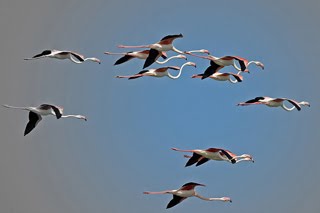
In desperation for migration I have made forays to areas on the periphery of my patch and although not producing anything like ‘spring migration’ I did manage a single Lesser Flamingo, Gull-billed Tern and 15+ White-headed Duck at Laguna Dolce, while thousands of Greater Flamingo were brought to the shoreline by high waters at Fuente de Piedra. During the visit to Fuente de Piedra it made my day to see large numbers of Pallid Swift (here since the backend of February) joined by reasonable numbers of Common Swift. Red-rumped Swallows glided among the many other hirundines and a few waders, including a staggering 7 Spotted Redshank, kept me amused.

So while I wait for spring to happen, never complete without iconic species such as Bee eater and Nightingale, I will content myself with watching such sights as Bonelli Eagle males bringing food for brooding females and male Golden Eagle calling females away from their labour to enjoy the day’s up draughts and thermals.

Oh and is it just me, but is there a big drop in Chiffchaff and Willow Warbler numbers this spring?

Sunday, February 21, 2010

A Winter's Tale

And so retribution has been cruelly dealt for having basked in unashamed glory during the autumn past! Golden sunlit days and balmy temperatures seem but distant memories as our mountains were plunged into the heaviest and most prolonged period of rainfall on record. Low temperatures, flooding and landslides conspired to keep any sane birder well locked-up in their nests, whilst optimism and unfounded faith in the law of averages soon waned with the sheer number of wet and grey days. Needless to say wading up to your neck in muck and water had a profound affect in curtailing the enthusiasm of an old warrior, who also had the cast iron alibi that leading tours to Gambia, Senegal and Costa Rica meant birding for the period could be achieved without any self inflicted hardship! Lame excuse for such behaviour, but then again you shouldn’t believe everything you read and also being birdwatchers yourselves, then you know very well what total idiots we can be by venturing out in the most appalling conditions. And so armed with soggy telescope, binoculars and clothing I put my best and most stupid foot forward and sallied forth into the grey murky mountains of the Serranía de Ronda.

I guess fortune favours the brave, or in this case a rather wet idiot. Have you noticed, no matter how tight you fasten your waist belt, rain water from your neck races down the recesses of your spinal track and ends up in the most uncomfortable of places? I am not sure why I should continue to be surprised by the fortitude and resilience of our birds, but with such harsh weather I expected to find very little activity among my birds, how daft a notion. The bumper harvest of Hawthorn berries ensured Ring Ouzel, Redwing and Song Thrush remained to squabble with competing Spotless and Common Starling, whilst the local flock of Crag Martins were accompanied by a single and one assumes lost, if not demented, House Martin. Alpine Accentor had, despite atrocious conditions, increased in numbers during December through to February and a single Fieldfare, a rare winter visitor, joined several Mistle Thrush on the scrub slopes of the lower Libar. Blue Rock Thrush were singing their song of spring in defiance of the weather and were constantly being interrupted by the aggressive and highly territorial Black Wheatear. Of course our regular residents and winter visitors appeared unaffected by the gloom and seemed to be present in their usual numbers, the only birds to be displaced were Common and Green Sandpipers, normally seen along the gentle flow of our rivers which by now had become raging torrents and higher than I have ever seen them.

On a very few clear days I managed to visit a few favoured haunts and was rewarded by excellent views of both Golden and Bonelli’s Eagle. Both of these handsome raptors are now adding materials to their nests and getting very excited by the close proximity of their chosen partners, fruity, aroused and copulating are they right now! Where the Bonelli gets very protective of their territory against all who trespass, the Golden Eagle seems remarkably uninterested and almost aloof, especially with the constant harassment from Choughs, but this mood is instantly changed when Ravens appear on the scene. It is hard not to make the larger birds anything other than the stars of my winter show; memorable sightings since December have included Spanish Imperial Eagle, Black Vulture, Rüppell's Vulture, Goshawk and most recently, admittedly not on my local patch, 18 Great Bustard near to Osuna. So bad as the weather has been, birding still provided highlights to lessen the burden of winter and now migration has already begun with Swallow, Red-rumped Swallow, House Martin and Black Kite passing in large numbers, whilst the odd Booted and Short-toed Eagle have added some extra spice along with Great-spotted Cuckoo.