Sunday, November 10, 2013

Sierra de las Nieves in Autumn

Despite forecasts to the contrary, the weather continues to provide us with crystal clear blue skies and warm days. A change has been the drop in temperatures at night time, but no complaints from me as the days can be spent outdoors and time catching-up with some autumn colours and wildlife. It is not quite time yet for the spectacular colour of the Alta Genal Valley, when the Sweet Chestnut Trees turn the whole valley gold and red, but won’t be long, possibly another 7 to 10 days. Our winter birds continue to flock into the area and provide opportunities for a photo or two, must be that they get more confiding at times due to feeling safer in the company of so many other birds.

European Goldfinch male
I’ve managed to spend some time in the area Sierra de las Nieves, a wonderfully scenic natural park that enjoys UNESCO Biosphere status. Some of the views we managed yesterday were just spectacular and everyone was struck by the beauty of these high mountains and accompanying valleys. I also managed at last to get some autumn colour into a few sneaky photo shoots. Birds were abundant in the river valleys, where fruit trees and seeding plants provide the main food source, but anywhere near water also offers plenty of insect activity for wintering warblers. Star for the day was a displaying pair of Bonelli’s Eagle and they were showing well as they indulged in their bonding ceremony.

Iberian Grey Shrike
Thought you might enjoy some of the scenery for a change, rather than lots of fauna shots. I certainly am always struck by the beauty of my mountains and very much hope you agree?


Sorry couldn't resist a fine Black Wheatear male (1st winter)

Why not join Peter on one his Day Tours? See Links below.


Serranía de Ronda – My Mountains – for further information read HERE

Osuna – Steppe Country – for further information read HERE

Campillos - Mountains to Lagoons - for further information read HERE

Wildlife Guides you can trust - Leading you closer to nature

Friday, November 8, 2013

Birds of Autumn - Serranía de Ronda

Unbelievably warm weather, butterflies and dragonflies abound, whilst winter clothes remain on the shelf. You could almost mistake the time of year as being the warmer times of spring rather than autumn. Only the mass arrival of wintering birds give the season away and even they have to be pleasantly surprised by blue skies and warmth. My mountains, my heaven and realm has seen the arrival of the most common winter visitors such as Black Redstart, Chiffchaff, Blackcap, White Wagtail, Meadow Pipit and Ring Ouzel, as well as the more localised Alpine Accentor. A surprise has been a solitary Yellow-browed Warbler up the Libar track, but then again there has been a large influx of these tiny warblers into Europe this autumn, still it got an old man very excited!

Mixed finch flocks abound in cultivated areas
Up on the high hills of Old Ronda there are super large flocks of mixed finches, spectacular sights as the flock are constantly disturbed by wandering cow herds, passing cars or the villain of any peaceful finch flock, the Sparrowhawk! It is always worth scanning these flocks for the unusual or scarcer finch and spending time revealed Brambling among the many Chaffinches, whilst the field margins with their high fennel plants held a small flock of Siskin. Just lazing around this wonderfully scenic area can take your breath away, as autumn shadows deepen the harsh edges to rock and crag, bringing a softness to the landscape which is almost velvet like and in total contrast to summer months when bright light and haze gives an almost one dimensional appearance to both hill and mountain.

Ring Ouzel are very common autumn migrants and winter visitors
Higher in the limestone mountains, where haws and hips provide food in abundance, Ring Ouzel has appeared in very large numbers, slightly later than normal. These handsome thrushes, so scarce and hard to find in North Europe, regularly use my high mountain areas to winter, along with Redwing and the much rarer Fieldfare. My maximum count for this thrush, during 2009, was 200+, whilst this week I have managed counts in excess of 100! Some of these birds will continue to journey south and eventually spend their winter in the High Atlas Mountains of Morocco, but a good many will winter here in times when there are plenty of haws and hips.

Meadow Pipit an abundant winter visitor
Of course we are only in the beginnings of November, so plenty of time for more seasonal weather, cooler and wet, to make an appearance, for now I am taking every available opportunity to get out of the house, not only for my guiding work, but also on my free days! And my efforts have been rewarded this week; I have not seen ‘my’ Bonelli’s Eagle behind Montejaque for many weeks so it was cause of great celebration to see an adult among many Griffon Vulture high above it’s nesting site. I was really so worried that something terrible had happened to ‘my’ eagles. Phew! What a relief. Black Vulture has also been regular this week up the Libar valley, such a different wing shape to their smaller cousins the Griffon Vulture.

Ibex - Large males guard their harem, warding off younger males!
As is becoming usual for my blogs I post several more photographs and hope you enjoy the pictorial of autumn here in my mountains? Thanks for taking the time to visit and read my blog.

An ancient Gall Oak
Mid-elevation Llanos de Libar
Black Wheatear are among the most attractive resident birds
Sardinian Warbler is our most common and widespread warbler

Why not join Peter on one his Day Tours? See Links below.

See links below for some great ways to spend a day!

Serranía de Ronda – My Mountains – for further information read HERE

Osuna – Steppe Country – for further information read HERE

Campillos - Mountains to Lagoons - for further information read HERE

Wildlife Guides you can trust - Leading you closer to nature.

Friday, November 1, 2013

October’s End and Birds


The last day in October saw bright sunshine, clear blue skies and warm temperatures, if a little cool first thing in the day. It was very tempting to visit the high mountain areas after witnessing a huge fall of Ring Ouzel the day before (30th October), counting over 100 in a relatively short drive along one of my favourite tracks, but I decided to take a look around the Canete to Teba area, whilst also allowing enough time to visit the Lagunas de Campillos. It turned out to be a good choice, especially seeing a pair of Bonelli’s Eagle over Teba Gorge, my first sighting for at least 3 weeks.


The day also allowed for a few photographs and again some valuable practise time with the toy camera Canon PowerShot SX50. With a little stealth, aided by some very large rocks and a stand of dried thistle plants, we were able to silently approach a small flock of Black-winged Stilt, normally quite skittish away from the proximity of public areas. Quite pleased with these early results and also with the few vulture shots. Hopefully you might enjoy them too.


For more information on the Serrania de Ronda and the Sierra de Grazalema please visit our website HERE

Monday, October 28, 2013

Sunday Driver - Serranía de Ronda


After some long overdue rain, not much to be fair, the sun came out; deep blue adorned the skies, whilst not a single cloud dared appear. Well, what did you expect I might do on such a day? Yep, of course you are right, I headed out to survey my local patch, my realm, the Serranía de Ronda, that most magnificent of areas with such a diverse range of habitats, it simply is the most wonderful of regions to live and explore. Birds, animals, flowers, scenery, culture and great food, what a combination to ensure you never get bored.


Not unnaturally the good turn in the weather brought out the locals in force, walkers joined the mushroom hunters and families were picnicking in the local natural parks, whilst I joined the many Sunday drivers, at least until I left the main roads and went on my beloved track to Llanos de Libar, the starting point of my route. There were plenty of birds around, made flighty by the number of walkers in the area, but I did manage a few peaceful moments and photograph a couple of species. Some winter visitors made their first appearance for me, 3 Alpine Accentors hopping around on the track, whilst a female Ring Ouzel joined the throngs of Spotless Starlings feeding on haws in the Hawthorn cluster near to the beginnings of the track.

Southern Autumn Crocus
At a much higher altitude Southern Autumn Crocus provided an opportunity to attempt some arty approach with my toy camera! Huge mixed finch flocks were around the cultivated halfway mark along the track and these were joined by large parties of both White Wagtail and Meadow Pipit, both winter visitors to the area. Thekla Lark proved very obliging for a change, they obviously didn’t realise I had my camera with me, so managed some half decent photos, examples of which appear on this blog. Northern Wheatear are still passing through and a new one for me this season, a male Merlin, made an unsuccessful swoop at one of the wheatears.

White Wagtail (immature male) fresh from a bath
The highest reaches of the track was to prove disappointing due to the number of mushroom hunters walking around scouring the meadows for their bounty. Aren’t these important fungi protected in this UNESCO Biosphere Park? If not why not, they are an important food source for insect and animal alike. Judging by the harvest, some of the collectors must have been gathering for commercial gain too! Probably me being grumpy due to the disturbance these folk created and only managed a few scenery shots before departing.

Black Redstart - large numbers in the area and increasing
The change in weather, now warm with clear skies, accounted for the number of Griffon Vulture in the skies, such large gatherings riding the thermals and up draughts, there were literally hundreds around the valleys and mountain tops. The influx of Black Redstarts continued apace with good numbers all along the track, they will soon peak and settle to a lesser number for the winter. Blue Rock Thrush and Black Wheatear were singing and enjoying the sunshine, whilst Rock Buntings continued to tease my efforts to get a decent photograph, little blighters!

Upper meadows of Llanos de Libar very quiet due to many mushroom pickers!
The end of my day was spent around the higher reaches of the Rio Guadiaro, where things were remarkably quiet for such a warm day. One thing that struck me was the lack of large numbers for Chiffchaff, they are normally abundant by now, but then again maybe they are more widely distributed due to the warm weather, seeking the sanctuary of the river in harsher conditions. Still, bent the old duffer’s back and took an upshot of the river and generally enjoyed wandering on the river bank.

Rio Guadiaro - got down low for this, but trouble getting back up, age!!
More photos of the day below.

Griffon Vulture - so many riding the thermals and up draughts.
Lower area of the Libar track
Thekla Lark - didn't spot the camera this time!
A Loosestrife? Not too sure about this one.. must look it up.
The ancient Oak Forest of the upper Llanos de Libar

For more information on the Serrania de Ronda and Sierra de Grazalema please visit our website HERE

For information about Worldwide Birding Tours please use this LINK

Thursday, October 24, 2013

Autumn's Road to Nature

Its official, autumn post migration is tough work for the birder! Or at least at higher altitudes, when even familiar birds, ones that don’t migrate, can disperse to lower lands! Of course my patch, the Serranía de Ronda, is so peaceful now, no holiday traffic, not so many walking the trails, just me and my toy camera! Even though by local standards this is the quiet time for birds, the cross over from summer departing migrants and the awaited arrival of wintering birds, there is still plenty to make the journey out of the door worthwhile, besides I am getting bored doing admin tasks!!


Autumn's (October) road to nature
Lately I have been sneaking days out, when really I should (must) do some administration work for the tour companies. However the lure of the great outdoors has been irresistible and the promise of winter is fresh on the winds, so I do not want to waste opportunities whilst the sun shines. Our days are still warm, the nights a little cooler, so I guess its no surprise to find plenty of dragonflies, butterflies and plants still attracting attention whilst walking the area or just driving around. Work also provided some nice birds plus some interesting ones like one of the photos below of a Thekla Lark with an abnormal upper mandible, just look how long and hooked it is, quite the reverse from what it should be i.e. blunt ended. Also a colour ringed Griffon Vulture (immediately below) and a Black-winged Kite in the area, which was a very pleasant surprise.

Griffon Vulture, Serrania de Ronda, Andalucia, Spain - yellow colour ring black lettering 15P
The photos below of Thekla Lark, ringed Griffon Vulture (above) and Black-winged Kite were taken by Peter Bonne Eriksen and reproduced here with the kind permission of Peter. 

Thekla Lark with abnormal upper mandible.
Thekla Lark above... Really a very strange individual with abnormal upper mandible. Normally the bill is blunt and hook tip more associated with Crested Lark, although some juvenile Thekla can have slight hook to U.M. Thought this might interest some of you.

Black-winged Kite - rare visitor to my patch!
All other photos are mine and were taken with the Canon PowerShot SX50.

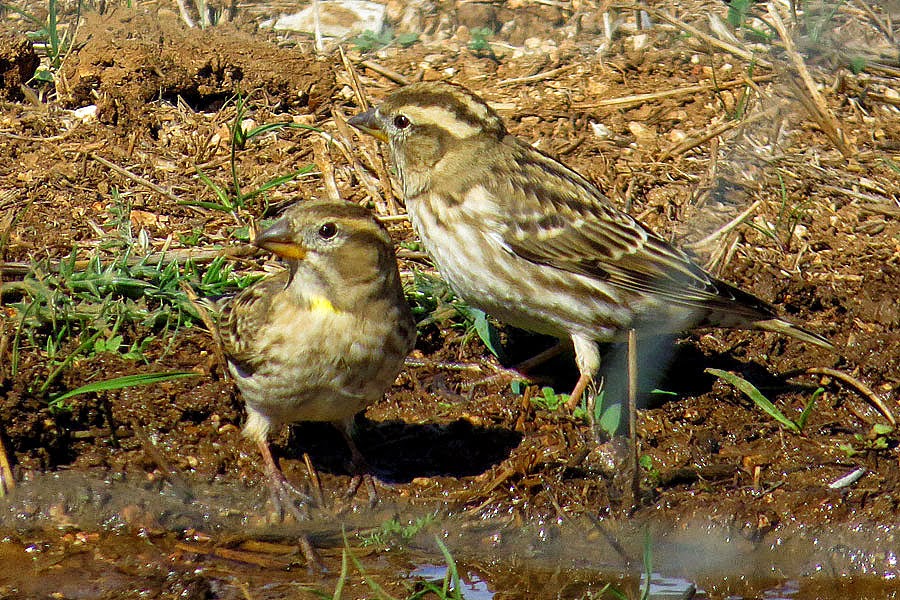
Rock Petronia / Rock Sparrow
Rock Sparrow or Rock Petronia above, not the best of photos, but it does help with id, especially the head markings which always show. Unlike the yellow breast spot seen on the bird to the left, this can be tricky to spot on most occasions. Another noticeable field mark is the faint white tip to the tail when the bird is flying away from you, which is very often the only view you get of this species!! I hope this might be helpful.

Western Willow Spreadwing Chalcolestes viridis
Collared Dove
Griffon Vulture
Mandrake
Red-rumped Swallow nest - wonder if they will use it next year?
White Wagtail - through the fence....

For more information on the Serrania de Ronda and the Sierra de Grazalema please visit our website HERE

For information on Worldwide Birding Tours please use this LINK