Wednesday, October 14, 2015

International Vulture Awareness Day


Himalayan Griffon Vulture
I want to celebrate and share with you International Vulture Awareness Day. These wonderful and spectacular families of birds, which I always promote with the term 'beautifully ugly', are an essential part of our world. Feeding largely on rotting carcasses, preventing the resulting spread of deadly disease, you would think people would do everything to conserve and preserve these creatures. Well, intentional and inadvertent interference by humans has pushed many species of vulture to the very edge of extinction. #LoveVultures
European Griffon Vulture
The vultures of our planet are classified into two groups: Old World and New World. The two groups are not related, similarities between them are considered to be a result of convergent evolution rather than any close relationship. In Eurasia only Old World vultures are found and unlike New World vultures, which have a highly developed sense of smell, Old World vultures find carcasses exclusively by sight like other birds from this family do with their living prey.

So what makes vultures so special? Well, to repeat myself and strengthened their case, you have to understand they feed mostly on carcasses of dead animals, generally not killing their own prey. As scavengers they play such an important role in the ecosystem, assisting the decomposition of dead animal matter, cleansing the environment and most importantly for us, they reduce the spread of harmful diseases. In short, there is no reason to harm this group of birds and every reason to support efforts to conserve them.
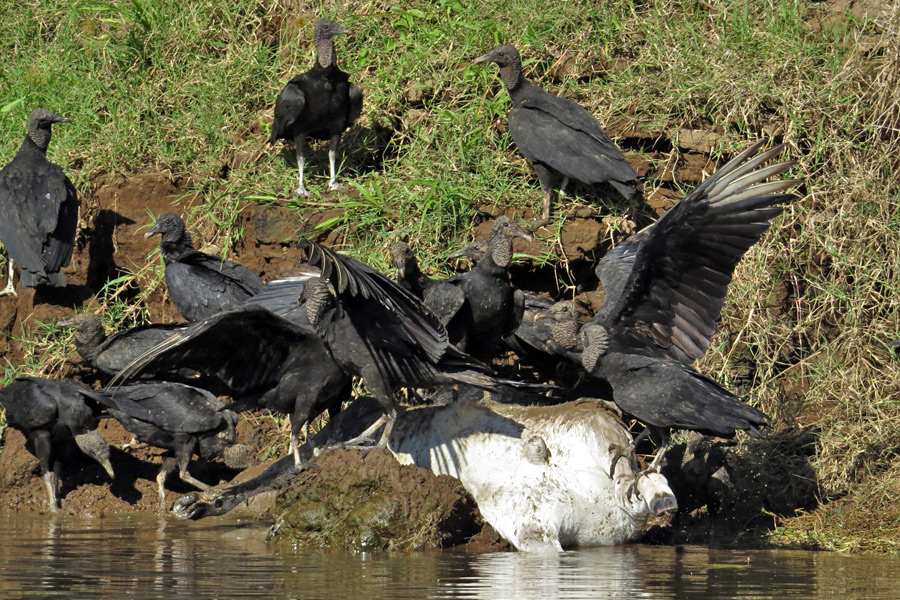
Black Vulture feeding on a carcass
What are the current dangers to vultures? You may have guessed it, human interference, intentional and unintentional. Old World and New World vultures are under threat, the consequences of which has and will impact on us all. Here are just a few of the problems faced by vultures from human interference.

1. United States, the California condor has struggled to maintain a sustainable population as lead poisoning continues to be the single most important threat to its survival. Hunters using lead ammunition will at times wound target species and allow them to die in remote locations. Condors feeding on the carcass ingest the lead shot and as a result are slowly poisoned to death.
2. In Eurasia it has been found that the use of Diclofenac, a painkiller for livestock and humans in India and Nepal, has caused staggering countless thousands of vulture deaths. Recently, Diclofenac has been banned, but conservationists argue that it has come too late to allow for survival of vulture species decimated by its initial use.
3. In African countries, such as Kenya and Namibia, farmers targeting lions and other predatory species that they consider a threat to livestock and humans lace carcasses with the extremely toxic carbamate pesticide Furadan. Animals that ingest Furadan suffer horrible deaths and then themselves pose a huge health risk to other scavenger species that ingest their carcass perpetuating this deadly act.
4. Across the European Union scavengers are threatened with extinction owing to a well intended, but ill-conceived regulation introduced by the EU government in Brussels. This regulation (1774/2002) dates from the year 2002, where the fear of BSE or “mad cow disease” was rampant in Europe and the EU, which issued a number of new directives to protect the population as much as possible from exposure to the epidemic. As part of these new regulations, it was decreed that dead cows, sheep, goats and horses would need to be disposed of in a licensed animal disposal facilities. Before this new regulation it was normal that when farmed animals died in remote and inaccessible pastures, particularly in Mediterranean countries, they were either left where they were or taken to designated carcass dumps.
Greater Yellow-headed Vulture
Notes on other threats to world vulture populations.

In the EU, Diclofenac has been authorised in animals since 1993. Currently, the medicine is authorised for use in cattle, pigs and horses in five Member States. Conservation organisations, citizens and politicians have expressed their concerns over the risks that Diclofenac may present to vultures and other necrophagous bird populations in the EU. In September 2014, the European Commission asked EMA to investigate whether the use of Diclofenac in animals presents a risk to vultures and other necrophagous birds in Europe and, if a risk is identified, to provide an opinion on actions or mitigation measures that could be implemented to manage this risk effectively.

Africa's vulture population is in danger from illegal elephant and rhino poachers, a South African conservation group is warning. VulPro says poachers have been poisoning the carcasses to prevent the vultures alerting wardens.
Vulture populations are facing steep declines across Africa due to poisoning and the illegal trade in vulture body parts fuelled by traditional medicine. According to the first comprehensive analysis of African vultures, published in June in Conservation Letters, populations of seven African vulture species have declined by 80 percent or more over the last 30 years.

Vulture species in the Americas are sometimes accused of carrying anthrax or hog cholera, both livestock diseases, on its feet or bill by cattle ranchers and is therefore occasionally perceived as a threat. However, the virus that causes hog cholera is destroyed when it passes through a vulture's digestive tract. The turkey vulture also may be perceived as a threat by farmers due to the similar black vulture's tendency to attack and kill newborn cattle. The turkey vulture does not kill live animals but will mix with flocks of black vultures and will scavenge what they leave behind. Nonetheless, its appearance at a location where a calf has been killed gives the incorrect impression that the turkey vulture represents a danger to calves.


Hooded Vulture
Lammergeier
Ruppell's Vulture
White-backed Vulture
Andean Condor


Wednesday, October 7, 2015

LA COVACHA: Turning a dream into reality

The Fund for the Stewardship and Recovery of the Salt Marsh (SALARTE) is a private non-profit entity whose purpose is to work to recover artisan coastal saltpans, to conserve biodiversity and to foster local employment based on endogenous resources.
The Bahía de Cádiz Natural Park is an amphibious territory. Down through the centuries, humans managed to reconcile conserving and enhancing its natural capital with the use of environmental services thanks to the sustainable use of the salt marshes, tidal streams, creeks and saltpans. Up until the middle of the 20th century, this territory, with a surface area of 10,522 Ha, was home to over 170 artisan saltpans, which generated biodiversity, economic resources and underpinned an exemplary social fabric. Only 4 artisan saltpans are still worked and 5,373 hectares of what had been world-famous saltpans and an example to all now lie abandoned.
The abandoning of the artisan saltpans led to a loss of environmental diversity and the degradation of key habits for migratory species of birds to rest, feed and breed along the Atlantic flyway. It also meant the squandering of countless natural resources that could help the recovery of a depressed socio-economy and, finally, the disappearance of the emotional bond between society and the territory.
After discovering this dramatic reality of territorial abandonment and loss of environmental quality in a province with a 40% unemployment rate, this team of professionals – who at the time had the advantage of working for the Public Sector – began to transform a salt marsh used for fly tipping, poaching and other illegal activities into what is now the largest Metropolitan Park in the Iberian Peninsula,   Los Toruños. We also organised two International Artisan Salt Fairs and worked to get Spanish legislation changed to ensure a level playing field to manage Spanish artisan saltpans on a par with countries such as Portugal and France. In 2012, we set up this NGO (Salarte) to recover salt marshes as a private venture.


SALARTE seeks to show that the sustainable management of salt marshes generates socio-economic benefits for the local population, fosters biodiversity, improves the functioning of natural processes and strengthens the bond between humans and their natural heritage.
Therefore, a year ago, we took over an old saltpan-island that had been abandoned decades ago. Thanks to our experience and steadfast work (with barely any resources and no public funding), we are gradually transforming it into a Natural Reserve that seeks to involve the human being in the salt marsh, increase biodiversity and showcase its wealth by organising lectures and guided visits to this legendary territory.
SALARTE is the only private NGO to manage a Reserve Zone of the Andalusian Network of Protected Natural Spaces, which is designated as a “Special Area of Conservation and is part of the European Natura 2000 Network.
La Covacha is an old saltpan with a surface area of 26.5 Ha.  It is part of the Trocadero Island and one of the main squares in Paris is named in honour of the Battle of Trocadero fought here.  Despite being a cultural, historical and ecological centre, the Trocadero Island enjoys maximum legal protection, even though it has been abandoned for decades.
Despite the numerous restoration and conversation projects by public authorities, the lack of upkeep and management of La Covacha meant that the tides and strong back wash had damaged the sluice gates and outside boundary walls that protect La Covacha from the surrounding marine environment.  This led to a dramatic drop in the numbers of spoonbill (Platalea leucorodia) using the colony based in La Covacha since 1996.
Convinced that civil society needed to take up the management of the saltpans and areas in the maritime-terrestrial public domain, SALARTE sought authorisation from the Regional Government of Andalusia to take on La Covacha for its integral management as a service for aquatic and marine biodiversity.


Salarte, a private NGO, is made up of young independent professionals that do not have sufficient economic resources to invest.  However, thanks to environmental volunteer drives, agreements drawing upon the expertise of shell fishermen and the organising of bird-watching routes, we have repaired the damage to the outside boundary wall, built new sluice gates and are managing the water inside the island to foster biodiversity and recover the island as a spoonbill breeding area.
During the spring and summer of 2014, the osprey (Pandion haliaetus) chose La Covacha as the site for the first attempt of non-assisted reproduction in the Bahía de Cádiz Natural Park since it was declared extinct as a breeding bird halfway through the 20th century.  Our aim is to use management resources to encourage osprey breeding in 2015 and future years.
Therefore, at the end of this winter and early spring, we made significant improvements to this island, which were urgently needed, and involving an investment of 7,000 euros. Even though the association lacked the funds, the SALARTE members decided to undertake the work even with the risk of having to donate the money themselves.  The construction company has been highly supportive of the project, lowered the cost of the works and agreed to allow us to pay in instalments.
Thanks to a successful crowdfunding initiative, we have managed to raise nearly half the cost of the works and La Covacha has welcomed spring and its nesting birds with a series of small but exciting improvements, consisting of:

  • Two nesting platforms and several artificial perches for the osprey.
  • A raised hide to monitor the spoonbill colony.
  • A refurbished tool room for the management and maintenance of the island.
  • A jetty to make it easier to access the island.
  • A photo/video camera to monitor the osprey.


Despite being quite common in the UK, land stewardship is a tool that is practically unknown in Andalusia.  We aim to set an example to show how important it is for civil society to get involved in restoring the natural environment and how it generates environmental benefits, leads to social improvements for the population and recovers territorial pride.
We are striving to get the general public to be committed to improving the territory and reproduce the Anglo-Saxon environmental management model in Andalusia.  We would therefore be delighted to welcome Andalucia Bird Society and nature lovers, with whom we have such strong ties and who have done so much down through the years to showcase the birds of Andalucia to scientists, nature lovers and enthusiasts around the world.
We would be delighted to welcome you to the Bay of Cadiz. SALARTE technicians will show you the secrets of the last traditional saltpans, explain how they work and let you discover the mythical La Covacha Island for yourselves.  The support of ABS members is fundamental for this project as an impetus to help this small organisation continue working on our common goal: knowledge about and respecting nature.


During a visit, some of the many birds you are likely to see include ospreys and spoonbills, flamingos, several species of gulls, great cormorant, caspian terns, gull billed terns, common redshanks, spotted redshanks, common greenshanks, common sandpipers, wood sandpipers, green sandpipers, curlew sandpipers, marsh harriers, hen harriers, booted eagles, common kestrels, turnstones, oystercatchers, grey plovers, European golden plovers, sanderlings, red knots, dunlins, black-tailed godwits, bar-tailed godwits, Eurasian curlews, whimbrels, kentish plovers, little ringed plovers, common ringed plovers. You will also be able to discover the seagrass meadows, which are home to many species of fish, shellfish, shrimp, prawns, sea horses and other important species.
A traditional fishing boat can take you through the tidal reed beds and sea grass meadows to disembark –at the brand-new jetty– on the island that the Hundred Thousand Sons of St. Louis seized during the Peninsular Wars. You will there learn how the marshland water is managed using sluice gates and walls, along with having time for bird-watching and to take in this unique scenery.
We look forward to welcoming you to the Bay of Cadiz and take you to La Covacha where you will discover the legacy of centuries of converging evolution between humans and nature.


Author: Juan Martín Bermúdez - Salarte. Bay of Cadiz - 2015
Edited: Peter Jones - Andalucia Bird Society. Andalucia - 2015

Monday, September 28, 2015

Serranía de Ronda A Wilderness

A wilderness and wildlife enclave of international importance.

Within the heartlands of Andalucía, nestling within Malaga Province, is a wilderness of outstanding natural beauty and importance. The Serranía de Ronda is a jewel in the crown of natural Spain and still remains one of the many spectacular wildernesses in Southern Spain.

It is an area rich in habitat diversity; this provides an ever-changing landscape for those visiting the region. Of course, such diversity in habitats produces a varied and remarkable wealth of fauna and flora. Not least of the area’s attractions is the birdlife and with around 250 species recorded, who can doubt it represents one of the principle birding hotspots in Spain.


A rather simplistic breakdown of habitats for the area will give you an idea of what the Serranía has to offer the visitor.

1. Montane and Scrub
Predominant habitat. The Penibaetic Range of mountains dips its toes into the Mediterranean on the eastern side of Gibraltar and into the Atlantic to Gibraltar’s western seaboard. It is as dramatic as it is stunning. The Serranía de Ronda and Sierra de Grazalema are situated amidst the limestone peaks. The area’s highest peak is Torrecilla at 1,919 metres. To the southwest of the Serranía the mountains are sandstone. The habitats of the area are varied and include sheer limestone cliffs, pine woods (P.sylvestris, P.pinaster), Spanish Fir (Abies pinsapo), grasslands, scrub and oak (Q.rotundifolia, Q.suber) woods. Amongst the flora there are several endemic species.

2. Steppe and Agricultural areas
Generally extensive and undulating, largely treeless and dry areas dominated by grassland habitats. These areas include large proportions of agricultural land. Sheep, cattle and goats graze grassland areas. Many of the agricultural areas are farmed in a traditional way using rotational cropping methods. Agricultural areas are diverse and range from rotational cereals to modern intensive winter wheat production. We also have large areas of fruit production, vineyards and both almond and olive groves. In the east of the range there are large areas given to the production of chestnuts and these woodlands are often mixed with oak such as Quercus rotundifolia.

3. Woodland and Dehesa
The area contains some impressive and extensive mixed woodland. Larger woodland is mostly the cork oak Quercus suber, but often contain other oak species. Oak are an import tree for the area and apart from the production of cork the variety of oak also provide acorns to feed large numbers of black pigs, which are the source of the area’s famed cured jamons. Although there is pine forest these tend to be associated more with higher montane areas. Dehesa is a description for open woodland or more correctly trees scattered over open grasslands and scrub type vegetation. These areas are often grazed by cattle, sheep and goats and can be very productive for birds.

4. Wetland (rivers, pools and reservoirs)
It is probably overstating the term wetland, but the marginal habitats of various rivers, pools and reservoirs do constitute wetland areas in an otherwise dry area. Of course the presence of water in such an arid landscape is an obvious attraction to many breeding species of bird as well as those on migration. Two major river systems the Genal and Guadiaro are constantly with water and a focus for specialist species such as the elusive Western Olivaceous Warbler and other sought after local birds. The reservoir at Zahara is the only large surface area of water in the area and is only rarely of any interest for birdlife. It does however provide a good site for White-rumped Swift!

Zahara Reservoir
Note: The Rio Guadiaro is probably the most interesting of our ‘wetland’ areas. It acts as a major highway for spring and autumn migrants. The river enters the Mediterranean near Gibraltar and is an obvious choice of route for many species of passerine and raptor.

The bird community of the Serranía is particularly rich and breeding birds include, to name but a few, Golden Aquila chrysaetos, Bonelli’s Hieraaetus fasciatus, Booted H.pennatus and Short-toed Circaetus gallicus Eagles, Griffon Gyps fulvus and Egyptian Neophron percnopterus Vultures, Peregrine Falcon Falco peregrinus, Lesser Kestrel Falco naumanni, Eagle Owl Bubo bubo, White-rumped Apus caffer, Alpine A.melba and Pallid A.pallidus Swifts, Blue Rock Thrush Monticola solitarius, Rock Thrush Monticola saxatilis, Black Wheatear Oenanthe leucura, Black Redstart Pheonicurus ochruros, Chough Pyrrhocorax pyrrhocorax, Rock Sparrow Petronia petronia, Rock Bunting Emberiza cia and Crossbill Loxia curvirostra. The Serranía and its surroundings include three major natural parks, Sierra de las Nieves (declared Biosphere Reserve by UNESCO in 1995), Sierra de Grazalema (declared Biosphere Reserve by UNESCO in 1977) and Los Alcornocales a richly wooded park and declared ZEPA reserve (zone of especial protection for the birds).

The Serranía de Ronda and Sierra de Grazalema, is unique and an important area for European birds. Not only is the area rich in breeding species, as previously mentioned some four different species of eagle nest here, but also because of its’ close proximity to the Strait of Gibraltar (only 14 kilometres from North Africa). It is an extremely important feeding area for migrant birds of western and northern Europe. Recent research has shown the importance of the area to several breeding species under threat. Such birds as Golden Eagle A. chrysaetos, Bonelli’s Eagle H. fasciatus, Egyptian Vulture N. percnopterus, Peregrine Falcon F. peregrinus, Black Wheatear O. leucura, Rock Thrush M. saxatilis, Orphean Warbler Sylvia hortensis and Chough P. pyrrhocorax, are all classified by the World Conservation Union (UICN) as being under varying danger levels of extinction.

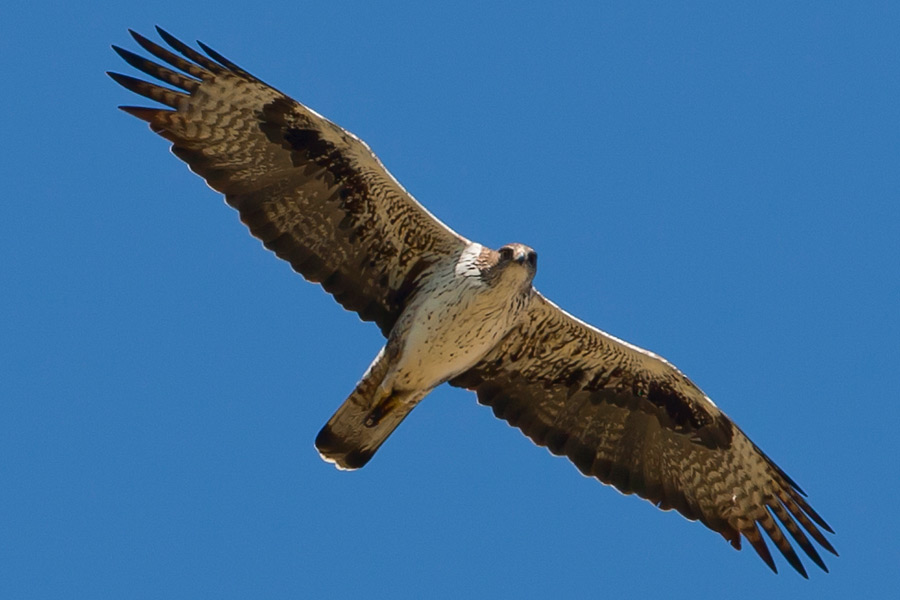
Bonelli's Eagle adult
Mounting pressures upon natural areas, from various interests, increase the need for knowledge and case building to protect this most important area. For me it has been depressing, although challenging, to have begun a research programme, where very little is available historically to use as a beginning, or by way of comparing with my own results. Once I began though, there were some very encouraging finds to my work i.e. a local healthy and still viable population of Bonelli’s Eagle H. fasciatus, despite local hunting interests! Note: Bonelli's Eagle. Perhaps the highest breeding density in Europe is here within the Serranía and Sierras.


Your support of ornithological tourism in the Serranía and Sierra will, I am certain, help raise the profile and importance for the need to protect the natural wonders of this unique area. Local people are far more likely to protect and preserve wildlife, if it can generate real income and contribute more fully to the local economy.

Birding map of the area.

Wednesday, September 2, 2015

The Wonder of Nature

Have you ever had that prickly feeling at the base of your neck, when your hairs stand up and you are in wonder? It is a kind of out of body experience, where your spirit dances with joy and you can feel with your eyes. Something reaches deep inside you, touches you and elates you. It is a warm and wonderful sensation. 


Nature sometimes touches me like this, either from a lonely vantage point, where the panorama is simply staggering or I chance upon a circumstance that allows a moment that connects me to an animal, you know that time, when you stand still alongside a wild creature that appears as curious of your presence as you are of theirs, unafraid and connected. Nature provides so many wonders, so many joyous moments, so much for free. It is refreshing and a way to release burdens and truly relaxes.


Rock Bunting a common resident at higher elevations
Most of those that follow my blog, Facebook or other social media, will know I am largely globe trotting leading or guiding tours. My time gets divided between these tours and my home patch, where I also lead tours and day trips. The home territory, Andalucia, also includes my backyard, the Serrania de Ronda. The summer this year has been the warmest since records began, scorching heat and dry. Despite these high temperatures I made many a foray into my mountains and even allowed people to accompany me, those brave souls were, as always, rewarded with rich avifauna and flora, with the occasional wild animal providing a thrill to cap their day. Most of all, friends accompanying me, were treated to some of the most breathtaking and beautiful scenery to be found anywhere in the world. It surprises many that such beauty and vast tracts of wilderness remain here in Spain.


Libar Track - now a popular destination for birders since I promoted it.
Yet, and because of the high daytime temperatures, this summer I spent several days in my own garden, well more like office and garden. The amount of wildlife visiting my small patch (postage stamp size) was diverse and plentiful. It was hard and also a mistake, not to venture outside of the office door without my small camera, you really didn’t know what might turn-up, what opportunity might be missed by leaving the camera indoors. Critters leaping, scurrying, drinking and fluttering all complimented the birds in and over the garden. Eagles, vultures and swifts are regulars overhead, whilst shrikes, finches and my resident owls made sure you weren’t always cricking your neck skywards. Anyways I thought I might dedicate this blog to nature in my garden, just to give you a feel of what is possible perhaps in your own backyard. Here's a few photos to illustrate why it has been tolerable to stay around my house this summer....


Corn Bunting on Echium seed
Griffon Vulture are resident and a regular overhead
Red-rumped Swallow are a breeding summer visitor
Booted Eagle breed locally and are often over the garden
Scarce Swallowtail one of many regular butterfly species
Weasel the local scamp!
Iberian Wall Lizard
Serin (male) more common in the garden during winter
Algerian Sand Lizard
Turtle Dove a regular every summer's day
Painted Lady can be very common in the spring
Our Booted Eagle (dark phase) being harried by Pallid Swifts
Woodchat Shrike infrequent but common in April
Hoopoe common visitor and breeds locally
Short-toed Treecreeper a fairly regular garden visitor on our oaks
Little Owl - everyday visitor and getting closer as trust builds
Honey Buzzard migration over our garden!
Well lots more species and photos, but do not want to tire folk with the garden folio... Till next time.